
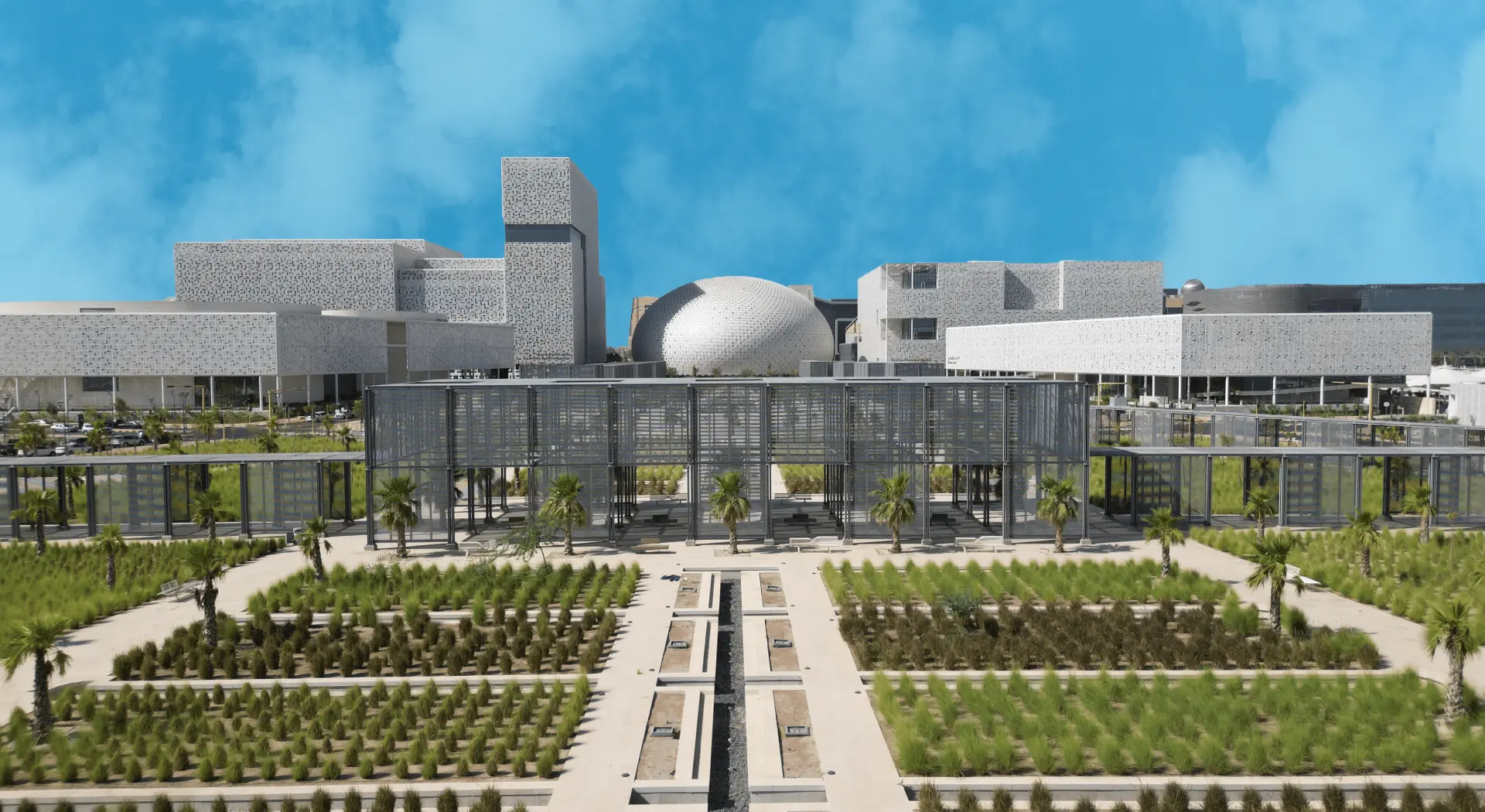
Under the patronage of the Minister of Education and Minister of Higher Education and Scientific Research Dr. Adel Al-Mane, and with the presence of Acting President of Kuwait University Prof. Meshari Al-Harbi, Acting Secretary General of the University Prof. Fayez Al-Dhafiri, Head of the Healthy Cities Office at the Ministry of Health Dr. Amal Al-Yahya, Representative of the Healthy Cities Office at the Ministry of Health and Director of the Healthy University Project Dr. Laila Al-Fuzai, Acting Dean of the College of Social Sciences and Head of the Healthy University Project Team Prof. Maha Meshari Al-Sajari, and a delegation from the World Health Organization represented by the Regional Expert for Healthy Cities at the WHO Eastern Mediterranean Region Dr. Samar Al-Feqi and the General Supervisor of the Healthy Cities Program and Director of the WHO Collaborating Center for Healthy Cities Dr. Mohammed Nasr Khashoggi, the WHO delegation conducted an official visit to evaluate Sabah Al-Salem University City as a healthy university city at Sabah Al-Salem University City - Al-Shadadiya.
In this regard, Acting President of Kuwait University Prof. Meshari Al-Harbi expressed his gratitude for the constructive cooperation and continuous follow-up since Kuwait University joined the Healthy Cities Initiative until reaching the final evaluation stage by the World Health Organization. He emphasized the great interest that various institutions and entities place on health, which is at the heart of global strategic policies and plans, noting that Kuwait University recognizes that advancing the educational process requires a commitment to promoting the health and safety of university community members, which is part of the university’s social mission.
Prof. Meshari Al-Harbi also mentioned that supporting the Healthy Cities Initiative aims to contribute to implementing a shared vision for health development and achieving sustainable development goals, raising awareness among individuals and society about healthy lifestyles, and improving community health. He indicated that the university’s commitment to following WHO standards and achieving health-promoting university goals was through systematic handling of various requirements to support the comprehensive health concept, and efforts were devoted to advancing all aspects that affect human health such as environmental, social, construction, research, psychological, and security aspects, in addition to preventive, therapeutic, and rehabilitative medical services, community participation, and institutional partnership.
Acting Secretary General of Kuwait University Prof. Fayez Al-Dhafiri explained that achieving the Healthy City project came as confirmation of Kuwait University’s developmental, cultural, and civilizational mission, which the university presents to individuals and society, achieving a strong and prominent position regionally and globally. He expressed his gratitude for all cooperation efforts between the university and health institutions that played a constructive role in following up on achieving the goals and standards of the Healthy Cities Initiative, which Kuwait University joined through its responsibility toward the educational process and achieving its advancement through a contemporary and advanced strategic vision to achieve its future goals.
Head of the Healthy Cities Office at the Ministry of Health Dr. Amal Al-Yahya clarified that Kuwait University’s strategy has always sought to present a distinguished model for improving the health environment with clear support from the university administration and all those responsible for Kuwait University, including faculty members and employees, for their sincere work in making this project successful according to WHO international standards. She emphasized that the transition from success to success can only be achieved through the efforts of all parties through implementation mechanisms and good governance, in addition to institutional commitment to the sustainability of all indicators, for this distinguished academic edifice to emerge in a manner befitting the State of Kuwait. She added that Kuwait University has become the basic nucleus in terms of training and education for other universities that have applied to join the Healthy Cities Initiative and implement the Healthy City project within the pursuit of achieving sustainable development with world-class quality services and elevating Kuwait’s reputation at local and international levels.
Dr. Al-Yahya added that the Healthy Cities project is one of the projects of the government work program for the 17th legislative term, confirming that the Healthy Cities program is one of the community initiatives adopted by the World Health Organization aimed at advancing public health, which requires concerted efforts of individuals, relevant government institutions, and research and academic centers to achieve the goal.
Representative of the Healthy Cities Office at the Ministry of Health and Director of the Healthy University Project Dr. Laila Al-Fuzai mentioned that the Healthy Cities Office’s contribution to the Sabah Al-Salem Healthy University City project, which is considered a pioneering national project, was through presenting facts about Kuwait regarding the civilized characteristics of the Sabah Al-Salem Healthy University City community, its distinguished architectural edifice, and the social and cultural progress achieved by Kuwait University. She confirmed that this distinction was the result of the vision of decision-makers and diligent work from all workers at all levels in various specializations and positions to become the pioneering project for health-promoting universities at the national and regional levels. She noted that new standards were developed and added to WHO standards to become 130 standards instead of 105 standards, built on experiences and studies from other universities.
Dr. Al-Fuzai also pointed out that the Healthy Cities Office held more than 25 events and meetings, and this project resulted in a memorandum of understanding between the Ministry of Health and Kuwait University, in which the Ministry of Health contributes to covering emergency, health, and preventive services for university students in its various clinics. This cooperation between Healthy Cities and the university also resulted in conducting studies on urban design and improving the surrounding environment in the city. She explained that during the work period with Kuwait University, the office received 3 requests from several other universities expressing their desire to join the Healthy University City project, and work on them was postponed until the completion of work in Sabah Al-Salem University City to be the pioneer and model to follow with its experience and partner with the Healthy Cities Office in the Healthy Universities accreditation program.
Acting Dean of the College of Social Sciences and Head of the Healthy University Project Team Prof. Maha Meshari Al-Sajari revealed that the Healthy City project is a purely voluntary project that does not aim for financial profit, but came as a fundamental step to transform Sabah Al-Salem University City into a healthy university city. The project required massive accomplishment through concerted efforts from university administration, faculty members, and all Kuwait University affiliates including male and female students. She noted that the university campus, which accommodates more than 40,000 students, managed to impress everyone with this distinguished health edifice, as Kuwait University students are the first spark of the project’s success. She added that Kuwait University was able, through the efforts of those working on the project, to produce continuous recommendations that serve the Healthy City project.
Members of the Kuwait University Healthy City Accreditation Project team presented a visual presentation on the history and details of Sabah Al-Salem University City, including facilities, departments, and buildings. The visual identity of the Healthy University City and the axes of the Sabah Al-Salem Healthy University City project were also presented to contribute to the WHO’s evaluation of Kuwait University.
The visit included an exhibition held at the Cultural Center and a field tour that included Kuwait University colleges, the Faculty Club, and the Oasis.
